

SafePay joint advisory: prioritize VPNs, edge devices and backup infrastructure
CISA, FBI, USSS and partners published a SafePay advisory on 20 October 2026. This report separates agency-reported scope, VPN access paths and verifiable defensive actions.
Updated: · Vietnam time (UTC+7)
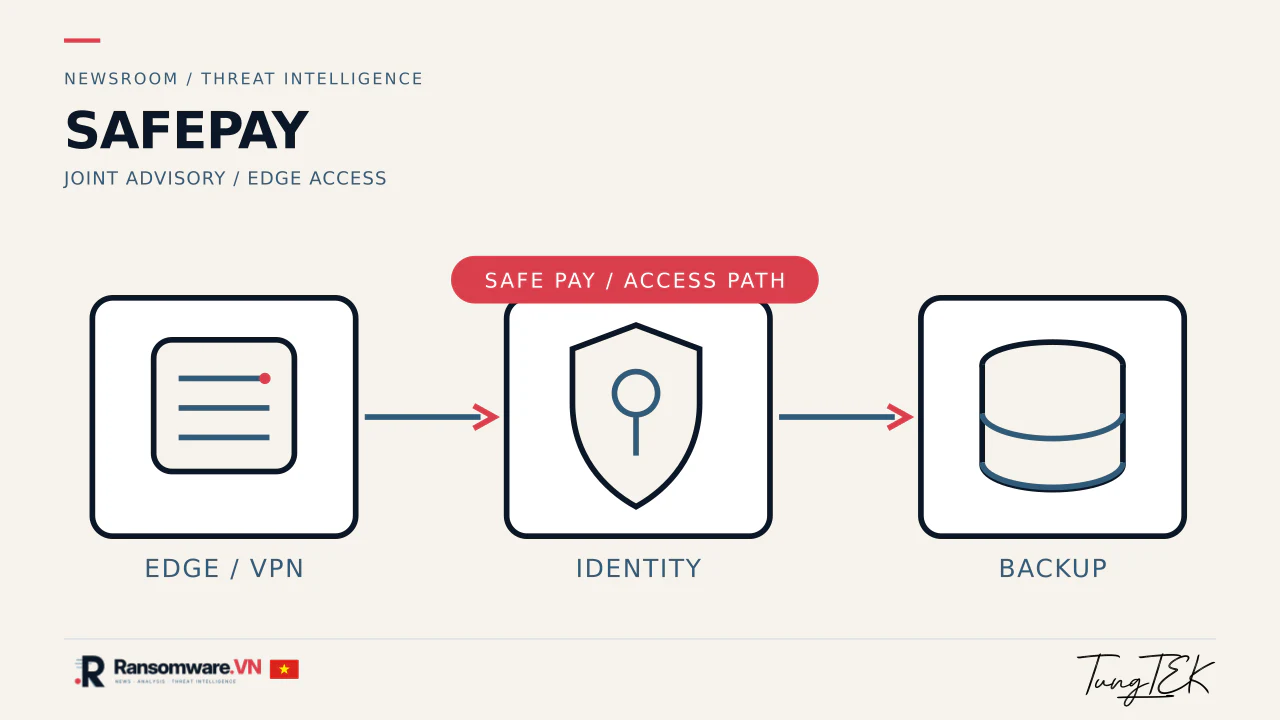
Publication of joint advisory AA26-293A by CISA, FBI, USSS and international partners on 20 October 2026 is verified. The figure of at least 600 victims is the agencies' reported scope, not an independent Ransomware.VN count. No primary source reviewed in this cycle confirmed a victim in Vietnam.
[S1] is the official advisory page; [S2] is the PDF version of the same document and is not treated as a second independent confirmation. IOCs and CVEs are investigative leads, not proof that a system was compromised. Artwork is illustrative, not incident evidence.
Evidence: joint advisory released on 20 October
CISA, FBI, USSS and international partners issued #StopRansomware AA26-293A on SafePay on 20 October 2026. It describes SafePay as one of the more active groups in 2026 and says the agencies have identified at least 600 victims across multiple sectors. This is agency-reported scope, not a victim list independently verified by Ransomware.VN. [S1]
Appearance in leak-site data or third-party statistics must still be distinguished from incident confirmation by the organization itself. This report stays within the joint advisory's stated scope.
Evidence: initial access centers on credentials and VPNs
The advisory describes initial access through exposed credentials, brute force and VPN exploitation. It also lists vulnerabilities for contextual review: CVE-2020-3259, CVE-2023-20269, CVE-2023-27532, CVE-2024-40711 and CVE-2024-40766. [S1][S2]
The list does not mean every SafePay case used every vulnerability. Investigators should correlate product versions, configuration, exposure windows and authentication logs before reaching a conclusion.
Evidence: publisher-prioritized actions
- Patch and review internet-facing firewalls, VPNs and edge appliances first.
- Reduce administrative privileges, restrict remote-management tools and apply appropriate Zero Trust controls.
- Enforce MFA and strengthen identity, credential and privileged-account governance.
- Correlate the STIX package and IOCs with local logs instead of blocking them without context.
Technical assessment: protect the recovery path
A practical priority for Vietnamese organizations is to inventory edge devices, identify unpatched systems, trace anomalous sessions and determine whether the associated identities reached backup, hypervisor or management infrastructure.
Backups should use separated privileges, immutable or offline copies and tested recovery procedures. Existing backup data does not by itself prove recovery is safe when administrative identities and orchestration infrastructure may share the same trust path.
Vietnam scope
The 21 October primary-source review found no qualifying official disclosure confirming a SafePay victim in Vietnam. This does not prove that no Vietnamese incident exists; it states the limit of the public evidence reviewed.
Sources
Each source's scope and date are recorded separately when available. A citation does not independently verify every assessment.
Update history
· Published VI/EN coverage of joint advisory AA26-293A, separating agency-reported scope, Vietnam verification limits and technical guidance, with six event-specific images.
Corrections policy