Ransomware .PIZ 2026: comparing eight cases recorded by TUNGTEK
Eight internal tickets: ransom demands, indicators, reference TTPs and attribution limits. The .PIZ extension does not establish a family.
Updated: · Vietnam time (UTC+7)

Eight cases published by TUNGTEK without publicly available original logs/samples for independent corroboration. .PIZ is a lead; Pizhon attribution is a reference hypothesis only.
Source record before consolidation
Original title (English translation): Case Study: Ransomware .PIZ 2026 and Eight Cases Recorded by TUNGTEK
Source: No.Ransomware.VN / TUNGTEK · Original date:
Original URL: https://no.ransomware.vn/tin-ransomware/ransomware-piz-2026/
The original is retained for comparison. The update history below records changes to sources, scope and assessments.
Profile information
- Dataset
- Eight tickets published by TUNGTEK; not independently verified
- Family
- Not confirmed — Unconfirmed
- Ransom
- A demand recorded in the source, not an amount paid
- Recovery outcome
- Do not generalize sample results to every case
Scope after consolidation
The original “Case Study: Ransomware .PIZ 2026 and Eight Cases Recorded by TUNGTEK” was published 26/09/2026. These are TUNGTEK's cases, not Vietnam ransomware statistics. USD 2,000–12,000 values are recorded demands, not evidence of payment.
The values and technical content below are retained for comparison. PIZ/Pizhon labels or note similarity must not automatically upgrade a family profile to Confirmed.
Read on the same topic: .PIZ via MSSQL: analysis of the case published by CyRadar. This is a separate case source; matching .PIZ extensions do not establish the same campaign.
01 / Field observations
Eight .PIZ tickets with different ransom demands
.PIZ is a ransomware case worth monitoring in 2026, especially across enterprise systems received by TUNGTEK. As of 25/09/2026, the original dataset records 8 ticket .PIZ, involving servers, file servers, SQL/databases, ERP and operational data.
| Observation context | Demand amount | Interpretation |
|---|---|---|
| .PIZ tickets | 2.000 / 3.000 / 4.000 / 5.000 USD | Recorded amounts; case counts by amount are not available. |
| One system with four machines | 6.000 / 8.000 / 10.000 / 12.000 USD | Amounts proposed within one case; do not add them into total damages. |
The differences raise questions about attacker pricing. Server roles, data types and disruption pressure may matter, but there is insufficient data to establish a pricing rule. Ransom demands also do not indicate how much data can be recovered.
02 / Careful identification
Why use PIZ-2026 / Pizhon-tracked?
360's May and June 2026 ransomware reports link the keyword piz to Pizhon. [1, 2] TEKLab uses PIZ-2026 / Pizhon-tracked as a temporary tracking identifier.
Matching extensions do not establish common source code, key mechanisms or encryption algorithms. Compare samples, ransom notes, execution artifacts and behavior before assigning a family or linking an attacker group.
Do not assume .PIZ is STOP/Djvu or “Rainbird”, or apply older Pizhon analysis wholesale to 2026 samples. “Pizhon-tracked” does not confirm an offender's identity.
03 / Identification indicators
Read IOCs with context
IOCs support identification and investigation. This table is edited from TUNGTEK/TEKLab records; its value lies in the combination of indicators, not one isolated string.
| Indicator | Observation / preserve | Interpretation limits |
|---|---|---|
| Encrypted extension | .piz, in the form filename.ext.piz | Do not assign a family from an extension alone. |
| Ransom note | Title ENCRYPTED FILES RECOVERY | Preserve the original note, filename, location and timestamp. |
| Email trong note | piztoreco@gmail.com | Attacker-supplied contact indicators, not a support channel. |
| Victim ID | Long hexadecimal string in the original record | Preserve per case; this article does not publish customer IDs. |
| Environment / data | Windows Server, file server, SQL/database, ERP/FAST, backup | Impact context, not an independent IOC. |
This publication has no verified malware hashes, control IPs/domains or detection rules ready for release. Do not add speculative indicators to blocklists. See using ransomware IOCs.
04 / TTPs to correlate
RDP, databases and remote-control software
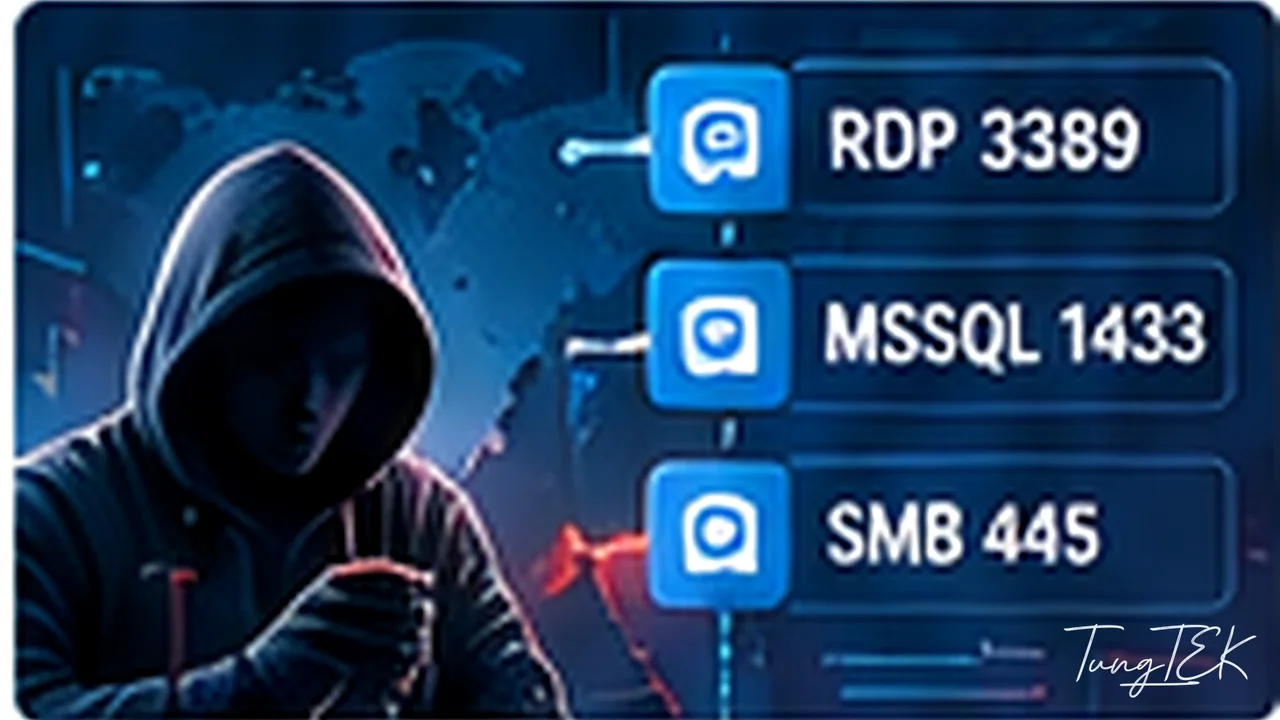
TTPs describe attackers' tactics, techniques and procedures. For piz, 360 describes RDP or database brute force followed by remote-control software installation to deploy malware. [1, 2]
These are investigative hypotheses for individual .PIZ cases, not proven causes for all eight TUNGTEK tickets.
RDP brute force
Correlate failed/successful logins, Remote Desktop sessions, accounts, source IPs and the first file changes. Exclude legitimate administration.
Database brute force
Review SQL/database authentication logs, Internet-accessible services, privileged accounts and unusual activity around the incident.
Remote-control software
Review remote-control software, services and sessions against actual support schedules. Installation of a legitimate tool alone does not prove intrusion.
360 also mentions possible encryptor self-deletion. [2] Failure to find an executable after an incident does not exclude malware. Correlate Event Logs, security history, Prefetch, Amcache and file artifacts such as $MFT, $UsnJrnl:$J if still available.
05 / Risks
Impact extends beyond files that will not open
- Operational disruption: unavailable databases or file servers can affect accounting, ERP and dependent services.
- Copies may not be safe: backups on the same system or managed by the same administrator account require separate integrity and restore checks.
- Artifacts may be lost: uncontrolled cleanup, overwrite, reinstall or rebuild can hinder investigation and extraction.
- Unauthorized access may persist: restoring files does not replace identifying compromised accounts, persistence and entry paths.
Possible data exfiltration must also be examined. This published dataset does not confirm exfiltration in all eight cases; do not infer data theft or its absence solely from the extension .piz.
06 / TEKLab observations
High entropy is a signal, not a conclusion
TEKLab observed high entropy in affected data regions of examined .PIZ samples. Entropy describes unpredictability in byte distributions; encrypted data can show this characteristic.
Compressed files, images, video and legitimately encrypted data can also have high entropy. It cannot alone identify a family, prove an algorithm, derive a key or predict a recovery percentage.
Examine block entropy alongside headers/footers, structure, intact regions, alteration patterns and control samples when available. For SQL, check pages and reconstruction prospects. This article publishes no unverified entropy scores or extraction percentages.
07 / Initial response
Preserve before changing systems
- Isolate affected scope. Disconnect appropriate network connections to limit spread and protect backups. Coordinate response staff to control ongoing encryption and evidence collection.
- Preserve valuable state. Keep ransom notes, Victim IDs, logs, file lists, timestamps and samples. Do not format, initialize disks, reinstall Windows, rebuild RAID or restore over original volumes before assessment.
- Inventory all related assets. Review servers, SQL, file shares, workstations, VMs/NAS and backup repositories. Identify data priorities for operations.
- Create working copies when appropriate. Qualified staff should image/clone devices and record hashes and collection details. Analyze, test tools and extract from copies; protect originals from overwriting.
- Assess before selecting an approach. Check clean backups, intact structures and extraction prospects through RFC. Do not run unsourced “PIZ decryptors” on servers or originals.
Read more ransomware incident response guidance and selecting and testing decryptors safely.
08 / Recovery perspective
No verified decryptor: individual assessment still matters
At this article's update date, TUNGTEK had not confirmed a public, independent, trustworthy decryptor specifically for PIZ-2026. The directory No More Ransom is a reference to check; the family and supported scope must match the actual sample. [3]
No suitable decryptor does not close every recovery route. Depending on the case, inspect independent backups, older versions, remaining copies or unchanged structures. Correctly encrypted regions protected by strong mechanisms may nevertheless be unrecoverable without the right key.
RFC – Ransomware Fast Check
RFC is TUNGTEK/TEKLab's technical assessment, not a decryptor. It asks:
- Which data regions changed and which remain intact?
- How far can logical structures be reconstructed?
- Is there a recovery source independent of the attacker?
- Is extracted data actually usable?
Validate recovery through files that open, valid logical data and usable applications. Do not promise outcomes from an extension, ransom amount or small sample alone.
09 / Lessons learned
Turn incidents into testable controls
- Control remote access: limit Internet-exposed management/database services; use secure gateways with MFA, appropriate source restrictions and privileges.
- Manage accounts and support tools: separate privileged accounts, review remote-control software and revoke unnecessary access.
- Backups must restore: apply 3-2-1-1-0, with offline or immutable layers, separate administrator permissions and actual restore tests.
- Logs must survive for investigation: centralize logs, define retention and preserve RDP, database and remote-software artifacts.
- Rehearse the first decisions: who isolates machines, preserves evidence, prioritizes data and accepts restored data as usable?
NIST IR 8374 Rev.1 (June 2026) places ransomware risk management across CSF 2.0: Govern, Identify, Protect, Detect, Respond and Recover. [4] For operators, prepare defense and recovery capability before an incident.
10 / Sources & scope
Field observations and references
This version is edited from “Ransomware .PIZ 2026: From Threat Intelligence to Eight Real Cases at TUNGTEK”, updated 25/09/2026. Ticket counts, ransom demands, emails/notes and entropy observations were supplied by TUNGTEK/TEKLab. This is aggregated internal data; customer identities are not published.
- 360 — May 2026 ransomware report. Reference for Pizhon identification and related TTPs
piz. - 360 — June 2026 ransomware report. Reference for entry paths and possible encryptor self-deletion.
- No More Ransom — Decryption Tools. An official tool directory for compatibility checks, not evidence that every variant is supported.
- NIST IR 8374 Rev.1 — Ransomware Risk Management. Governance, response and recovery under CSF 2.0.
Read the in-depth eight-ticket article on CuuDuLieuMaHoa.com to compare the analytical foundation. The earlier .PIZ profile covers the initial received cases with its own scope and update date.
Sources
Each source's scope and date are recorded separately when available. A citation does not independently verify every assessment.
Update history
· Consolidated from No.Ransomware.VN, preserving technical content, images and provenance. Links, metadata and verification scope standardized.
Corrections policy🇻🇳 Data incident? Call TUNGTEK. Service channel: CuuDuLieuMaHoa.com