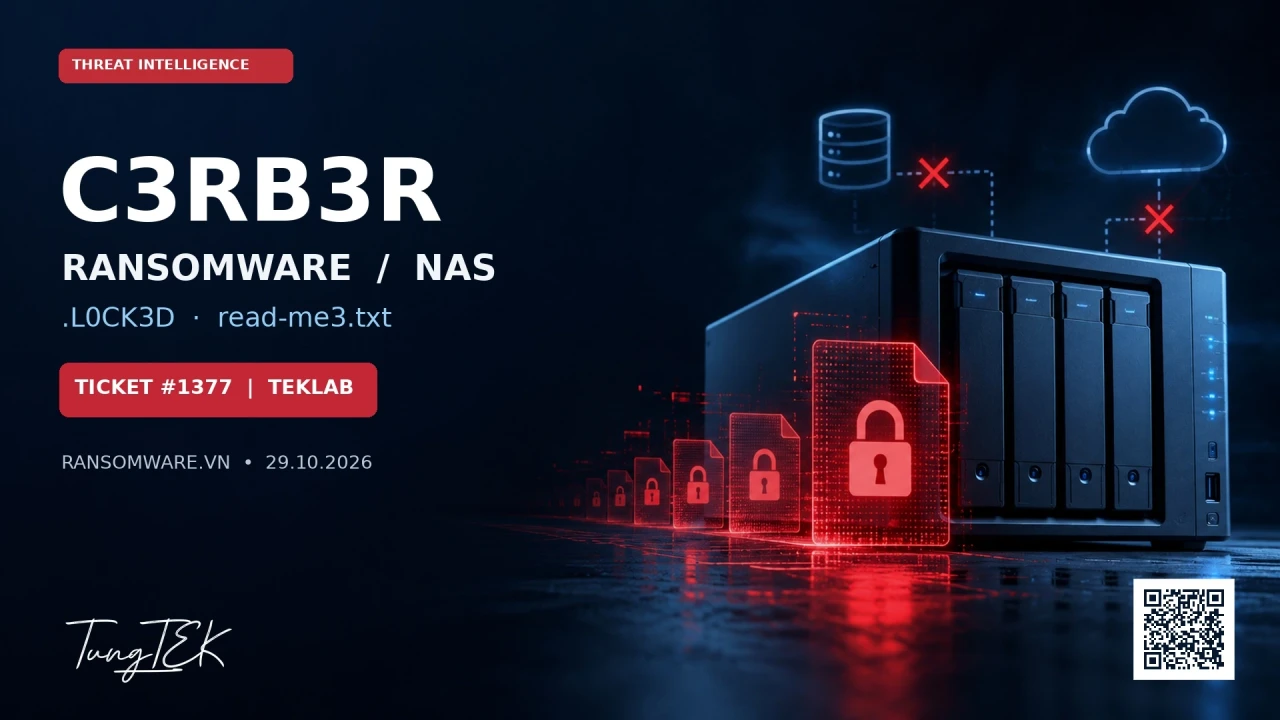

C3RB3R / L0CK3D: Synology NAS decryptors exist, but recovery depends on preserving evidence
TEKLink222 reviews three public recovery projects, RAM and session material, post-shutdown limits and the risks of overwriting source files during recovery.
Updated: · Vietnam time (UTC+7)
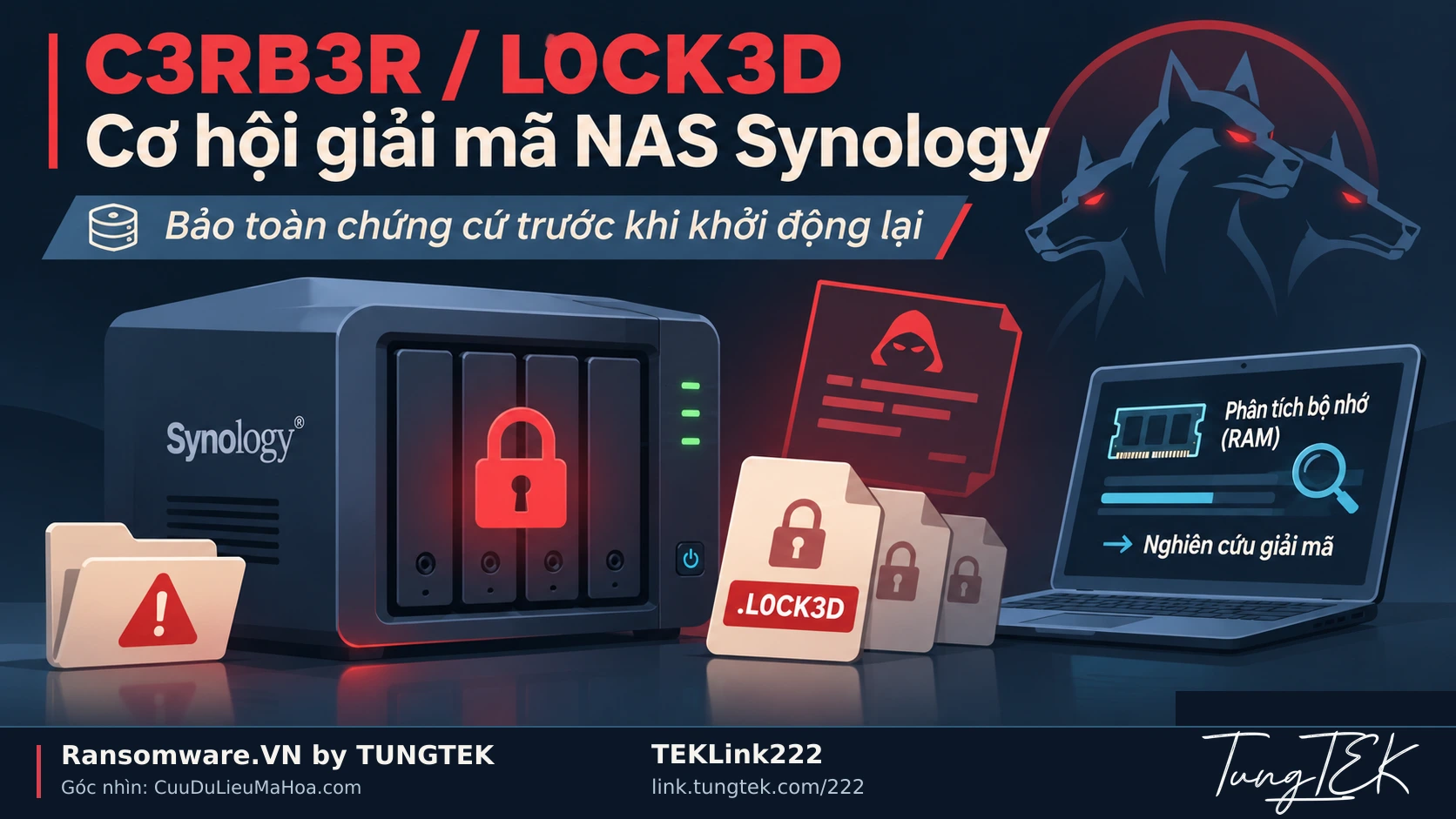
Three public repositories, technical references and Synology notices were reviewed on 1 November 2026. The code and author reports are public; Ransomware.VN has not rerun the tools or examined original incident data. Compatibility, keys and recovery for another NAS remain unverified.
AI-assisted analysis from TUNGTEK materials and public sources, separating author reports from editorial assessment. No customer data or new private-ticket outcome is published. TEKLink222 returned HTTP 404 when checked on 1 November 2026.
What readers should know
Publicly available C3RB3R/.L0CK3D recovery projects describe a route to decrypting some affected NAS files without paying a ransom: preserve the relevant memory, recover that encryption session’s material, validate it and decrypt independent copies. The authors report successful cases, but those reports do not establish a general success rate or support for every Synology model, DSM release or ransomware variant. [2][3][4]
The central decision: preserve recovery options while containing damage. A reboot, deleted artifact or write to the affected storage pool can make a promising investigation harder.
The recovery perspective of CuuDuLieuMaHoa.com by TUNGTEK runs through this article: stopping further damage, preserving evidence and restoring usable business data are separate objectives. Completing one does not automatically complete the others.
What changed in the reports of 30 October 2026?
A Chinese news report on 30 October drew attention to memory-based NAS recovery. Its broader claims, including universal DSM support and a fixed 110 MB/s rate, should not become technical promises for a particular incident. It is a secondary news source, rather than validation of every tool or device. [1]
The firmer reference is the projects’ own documentation: published code, preservation procedures and case reports describing how outputs were checked. Separately, Synology’s 29 October notice says attackers are exploiting a vulnerability patched in December 2024 against outdated DSM systems. The notice points to SA-24:20 without establishing one named CVE or entry route for every incident. [5]
These are different evidence layers. A vendor warning establishes a patching and exposure concern; community recovery reports establish observations within their authors’ cases. Neither makes every victim’s investigation interchangeable.
Check the character: the reviewed projects use .L0CK3D, with a zero after L. The news report sometimes uses .LOCK3D, with O. Preserve the actual names from the affected system.
Identification and encryption: keep the sample boundary
Reported indicators include .L0CK3D, read-me3.txt and encryption metadata appended to files. The analyzed format uses ChaCha8 for file contents and AES-256-CBC to protect per-file key records with session material; the authors describe a 588-byte footer and full, head-only and segmented modes. These are findings about the analyzed sample and format, not a specification for every C3RB3R variant. Technical reference.
The opportunity comes from potentially surviving session material in memory, not evidence that the encryption algorithm is trivially broken. Suitable material can unlock the footer records and enable decryption of matching files. Removing a footer alone does not decrypt their contents.
A key recovered from one incident is not automatically useful in another. Check the executable, file layout, session markers and known-original file pairs. Matching a short marker is a grouping lead, not cryptographic proof that two cases share a key.
Three public projects and their different priorities
| Project | Focus | Limit to retain |
|---|---|---|
| soimy/c3rb3r-rescue | Evidence preservation, memory-key recovery, copy decryption and a separate Btrfs route. | No universal key; test independent copies and distinguish verification levels. |
| Benjamin-zlt/c3rb3r-baremetal-rescue | A physical DSM case using process-memory acquisition and its own recovered session material. | Executable-specific assumptions, addresses and extraction methods need review. |
| penv13/c3rb3r-inplace-rescue | Direct file restoration for large or capacity-constrained storage pools. | Overwrites the source file; preservation and verified rollback come first. |
Benjamin-zlt reports approximately 84,500 files, around 940 GB, recovered in an Xpenology DS918+/DSM 7.2 case, with sample comparisons to originals. Penv13 reports 3,863 files and approximately 2.32 TB. These are project-author reports, not independently accepted recovery percentages for all variants. [3][4]
Soimy describes an approximately 49 GiB GitLab backup restored with memory-derived material and checked against a historical digest. Ransomware.VN has not rerun the workflows or examined the authors’ original incident data. The examples support further assessment, not a promise about another organization’s NAS. Soimy’s community review also records unsuccessful key searches; uptime or a valid-looking structure does not establish success. [2]
Why memory may matter more than repairing a file
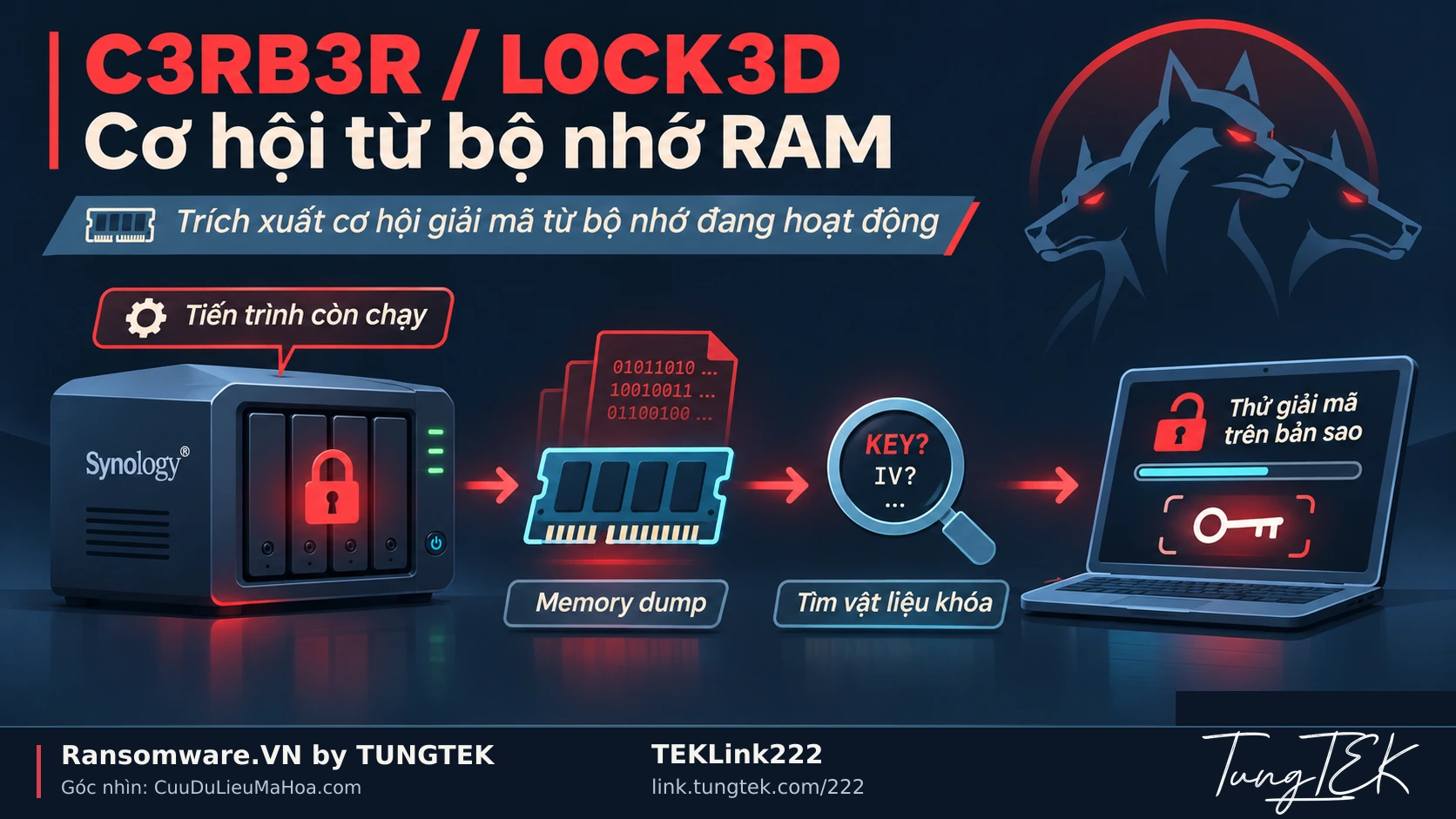
On a running NAS, encrypted disk files are only one part of the scene. Process state and retained memory may contain material that disk-only examination cannot replace. Rebooting to “clean up” the machine before acquisition can destroy that opportunity.
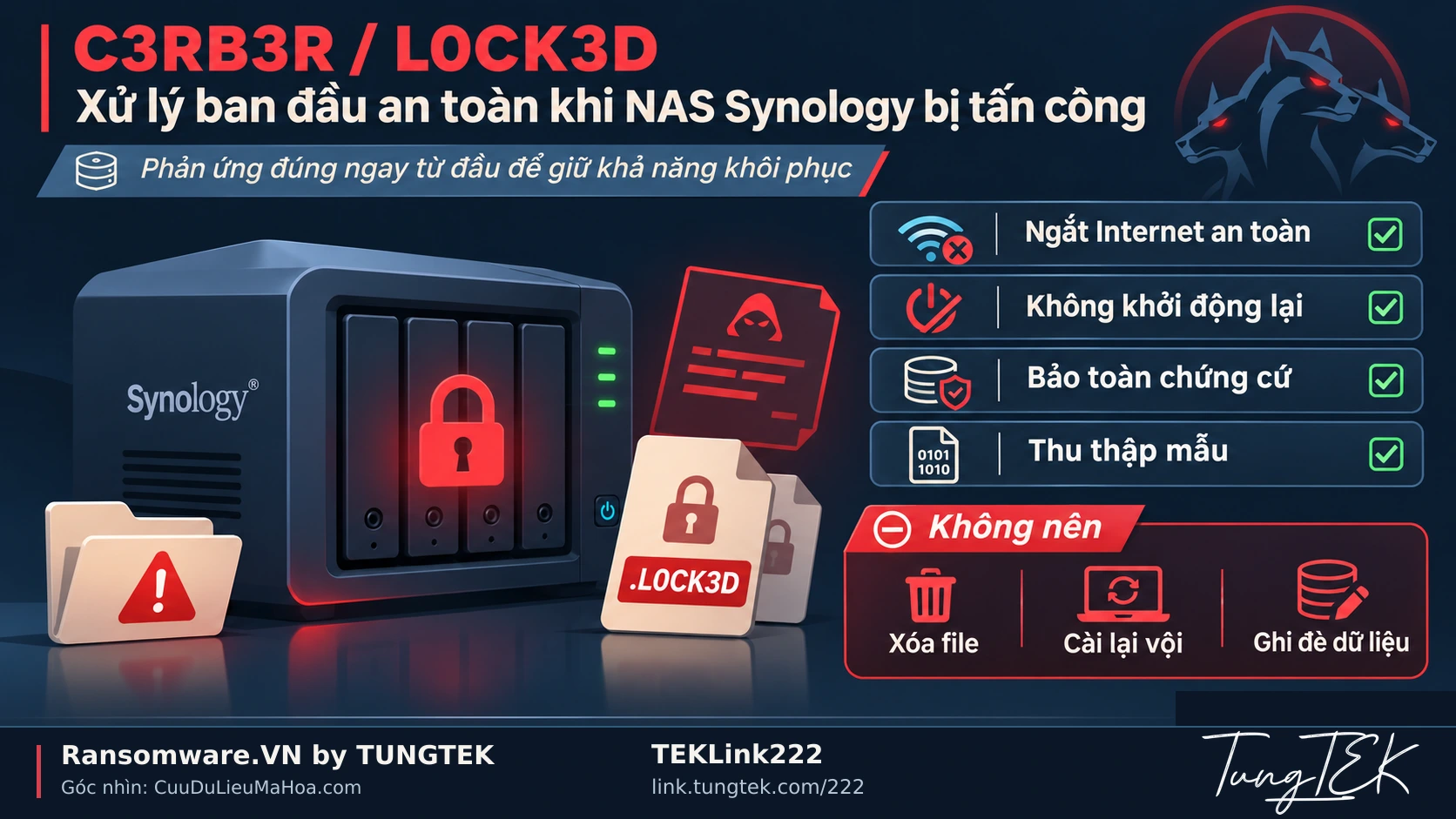
TUNGTEK’s response perspective is to assess continuing harm and preservation together. Network containment at a switch or firewall, with a restricted trusted management channel, may preserve more options than disconnecting every link and losing the only safe means of acquisition.
Some project instructions use kill -STOP to stop a verified encryptor without terminating it. This is not a command to apply to arbitrary process names. Identity, PID, thread states, privileges and system effects need review; a thread in D is not the same as a stopped T state. Acquisition requires a verified independent destination, sufficient capacity and documented coverage. Physical acquisition guidance.
Priorities for four common NAS states
| State | Assessment priority | Limit |
|---|---|---|
| NAS running; suspected encryptor alive | Contain access, preserve relevant memory/executable evidence and test candidates on copies. | Incorrect process intervention can lose evidence or disrupt services. |
| Process exited; NAS not rebooted | Preserve existing dumps and assess remaining RAM/used swap alongside snapshots. | Uptime does not guarantee that a usable key survives. |
| NAS powered off or rebooted | Preserve disks/RAID, snapshots, backups and pre-existing dumps; assess filesystem options. | Booting again cannot recreate the former process memory. |
| Multiple volumes, LUNs or virtualization | Map pools, RAID, iSCSI LUNs and VMs before choosing acquisition and recovery targets. | A regular-file workflow does not automatically apply to a block LUN. |
After shutdown, recovery is wider than finding a decryptor
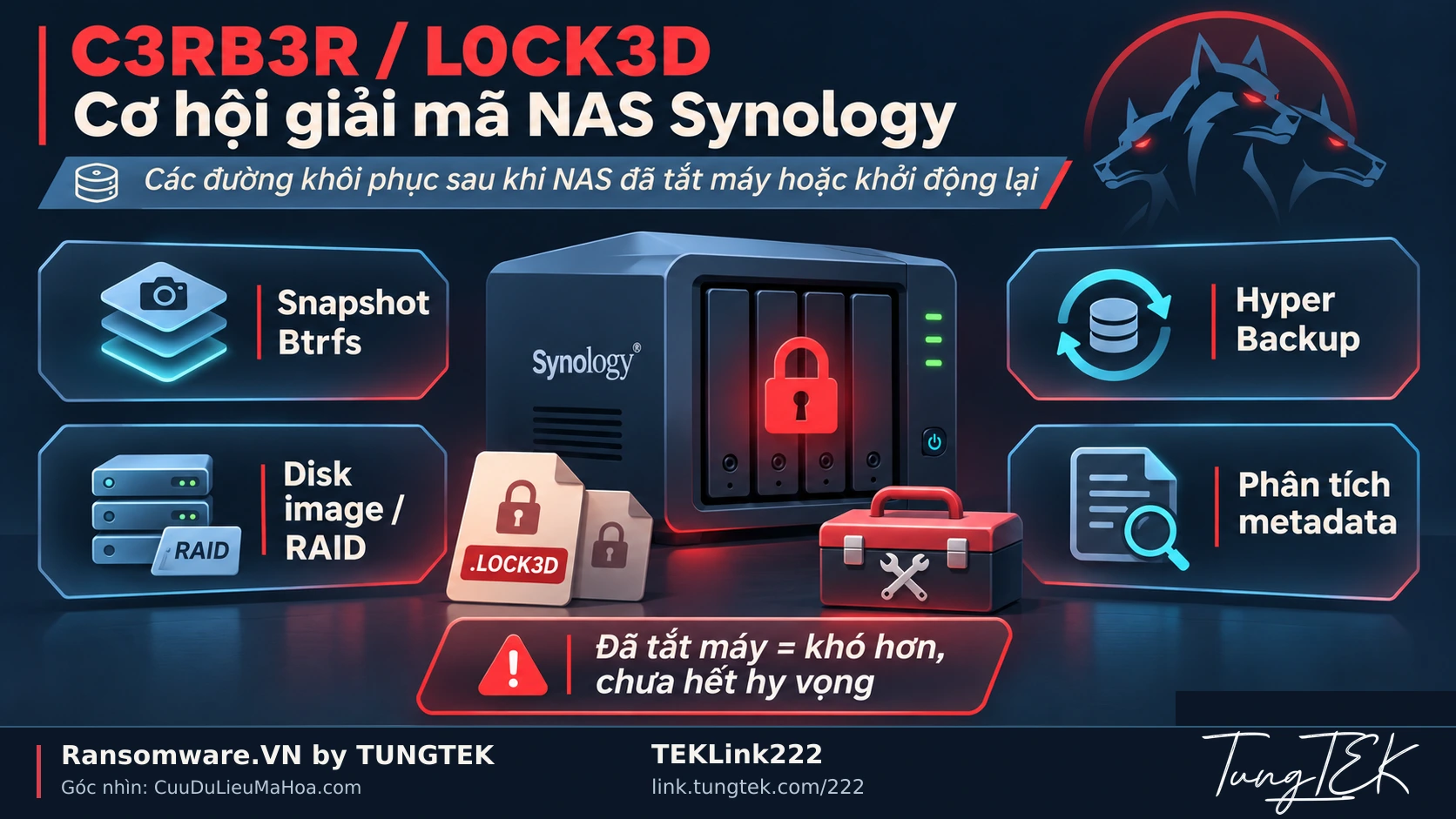
Once the previous process state has gone, the direct live-memory route may be unavailable. Existing memory captures, Btrfs snapshots, Hyper Backup, workstation copies and surviving older filesystem data may still deserve examination. Btrfs reconstruction depends on actual extents, metadata and subsequent writes; a Btrfs or NoCOW label is not a recovery guarantee. It reconstructs surviving data rather than decrypting ciphertext. Btrfs conditions and limits.
For RAID groups, thin/thick iSCSI LUNs or NFS datastores, preserve the physical-to-logical map: disk order, array parameters, volume and LUN state, and VM dependencies. A volume disappearing from the interface may involve configuration or metadata; it does not independently prove that every sector is encrypted.
CuuDuLieuMaHoa.com by TUNGTEK prioritizes the most valuable viable data path. A consistent copy of the VM or database needed to resume business may be more useful than attempting every volume without a validated plan.
In-place recovery: capacity savings with an evidence tradeoff
Penv13 describes overwriting encrypted segments and truncating the metadata trailer, supporting its analyzed full (0x24), segmented (0x25) and head-only (0x26) layouts. That can reduce the need for a second full-size output copy. It does not make every NAS, file layout or filesystem allocation behavior compatible. [4]
Source writes can erase evidence and remove the ability to retry. Incorrect truncation can cause irreversible loss. “No additional full copy” also does not establish that copy-on-write or metadata operations require no space.
TUNGTEK’s preferred sequence: retain ciphertext and decrypt independent copies first. Consider in-place work only with preserved source data or reliable rollback, a validated key, reviewed writes and authorized risk acceptance. Dry-run is not a substitute for complete-file comparison and application checks.
An RFC assessment framework for C3RB3R NAS incidents
RFC — Ransomware Fast Check — should produce a bounded, documented assessment. The following is a proposed working framework, not a guarantee of decryption or a substitute for the broader incident investigation.
- Record device state, discovery and reboot history, model/DSM, RAID/volume map and dependent services.
- Contain untrusted connections while retaining restricted management access where needed for preservation.
- Collect authorized representative encrypted samples, notes and logs; record provenance and SHA-256.
- Determine whether a relevant process survives and plan memory/executable acquisition.
- Document disk mapping, RAID, volumes, Btrfs snapshots, LUNs and NFS/VM relationships.
- Create appropriate forensic copies or clones, protecting the source against writes.
- Review the tool revision, sample compatibility and encryption layout beyond the family name.
- Test copied samples against known-good versions, complete digests and application structure.
- Prioritize recovery data, independent target capacity, copy time and remaining risks.
- Report verified findings, unresolved questions, the tested sample denominator and the recommended path.
Opening a file does not establish consistency of a SQL database, VM, mailbox or enterprise application. Use suitable integrity checks and isolated application tests, and record partial or unverified results separately.
Recovery must be followed by intrusion remediation
Synology’s 29 October warning says attackers are using a vulnerability patched in December 2024 and directs users to SA-24:20. That advisory covers several CVEs, including CVE-2024-10441 RCE. Do not turn the month in the warning into automatic attribution to one CVE for every victim. [5][6]
Review logs, accounts, tasks, exposure and connection history to establish the incident’s own path. Restored data on a still-compromised system can be encrypted again.
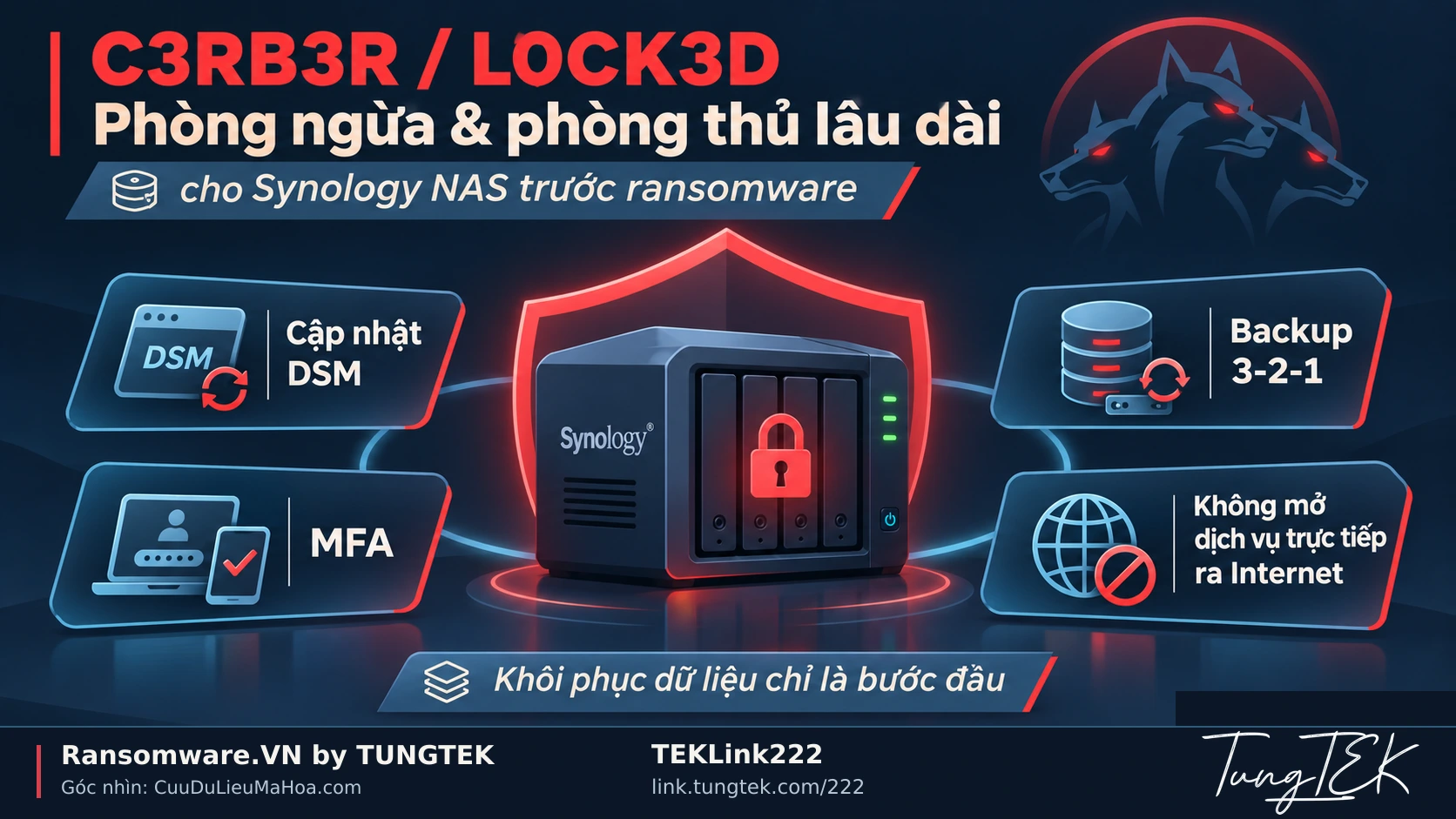
- Install model-appropriate supported DSM and package updates through a planned clean-recovery process.
- Reduce public management exposure and use secured access with source restrictions.
- Protect privileged identities with MFA where supported and replace affected credentials/tokens.
- Maintain versioned backups and offline/immutable copies beyond production-admin control.
- Exercise restoration of LUNs, VMs and databases, not only a few documents.
Frequently asked questions
Can a key from another NAS decrypt my files?
No universal cross-victim key has been established by the reviewed evidence. Bind candidate material to the relevant session and validate it against the affected files.
Is recovery still worth assessing after shutdown?
It may be, depending on backups, snapshots, surviving filesystem data, disk images or earlier memory captures. Starting again does not recreate lost process memory.
Can I run a GitHub tool directly on production?
Public code alone does not establish compatibility or safe behavior. Review the revision, runtime, writes, output destination and permissions; prioritize independent test copies.
Should the organization pay for a key?
Assess recovery alternatives, backup state and organizational consequences with the authorized response team and decision-makers. Payment does not guarantee a working key or deletion of stolen data.
Recovery begins with the first decision
The public tools are useful evidence of a possible recovery route, not proof that one command will restore every NAS. Memory preservation, key validation and controlled recovery matter as much as locating a repository.
The goal of CuuDuLieuMaHoa.com by TUNGTEK is usable, validated business data with understood loss and risk: preserve the source, assess compatible decryption, examine independent copies and validate applications.
TEKLink222: a recovery opportunity starts with preserving the evidence needed to assess it.
Related: TEKLink218 — C3RB3R case information and identification limits. This article reviews public tools; it reports no new customer-ticket recovery outcome.
Ransomware.VN by TUNGTEK · Recovery perspective: CuuDuLieuMaHoa.com · 0963509115.
TEKLink222: link.tungtek.com/222. Checked on 1 November 2026: HTTP 404. Share the full Ransomware.VN article URL while the shortlink awaits configuration.
Sources
Each source's scope and date are recorded separately when available. A citation does not independently verify every assessment.
Update history
· Published TEKLink222 in VI/EN after checking three projects and Synology sources. Retained author-report boundaries and evidence-preservation conditions. Five illustrations use the genuine PNG signature; TEKLink222 currently returns 404.
Corrections policy