

Babuk / BabyK on NAS: cryptography, data loss and forensic recovery
In-depth Babuk/BabyK NAS and ESXi analysis: ECDH, ChaCha20/Sosemanuk, attacker decryptor risks, file-state triage, RAID preservation and recovery.
Updated: · Vietnam time (UTC+7)
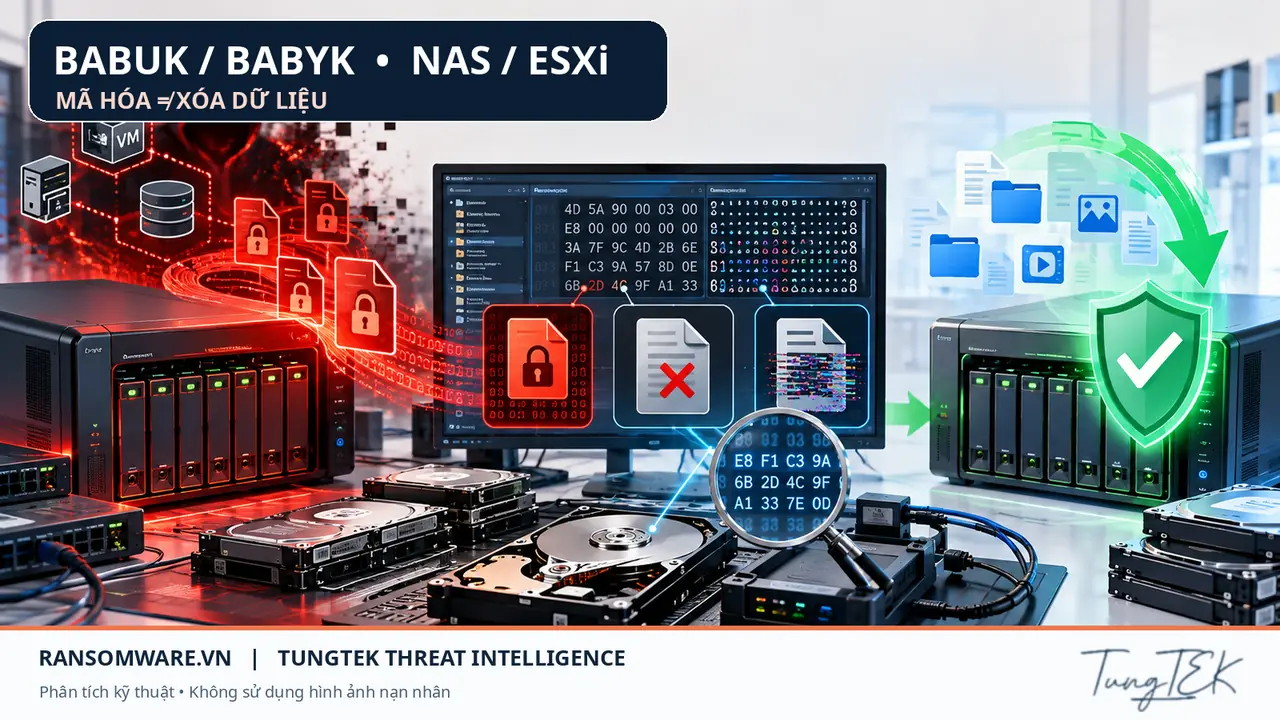
Cross-checked Emsisoft, Kudelski Security, Cisco Talos, Avast, SentinelLABS, VMware and NHS England Digital. Harmful decryptor defects are documented for the studied ESXi branch; destruction of every Babuk NAS file is not established. No victim evidence is released.
Historical forensic analysis from 2021–2025 research, expanded 25 October 2026, not a newly confirmed attack. Figures are editorial graphics with original PNG signature, not incident photography. Figures 2–3 link to separately persisted editorial media. [S1]–[S7] refer to the source list.
Executive summary: a .babyk extension does not prove the file's fate
Babuk/BabyK has Windows, VMware ESXi and NAS branches. The .babyk suffix alone cannot establish full encryption, partial encryption, rename-only behavior or secondary file damage; byte-level and filesystem evidence is required. [S1][S2]
Paying a ransom cannot guarantee recovery, but public research also cannot establish that every Babuk NAS case destroyed all original data. Distinguish documented findings from hypotheses requiring real forensic examination. [S1][S4]
1. The 2021 leak and distinct NAS/ESXi/Windows branches
Babuk emerged in 2021. Leaked source code and builders allowed other groups to reuse components. SentinelLABS identified ten Babuk-derived ESXi locker families in its 2023 study, not as a current total for October 2026. [S2][S5][S7]
Kudelski Security describes the NAS branch as Go-based and buildable for ARM/x86. Other branches differ, and a shared extension or code ancestry does not prove shared key material, threat-actor identity or decryptor compatibility. [S2][S5]
- Distinguish NAS hardware, RAID volumes, filesystems, SMB/NFS/iSCSI and VM files residing on network storage.
- ESXi decryption success should never be extrapolated to NAS by default.
2. Cryptography: ECDH/Curve25519, stream ciphers and footers
Studied Babuk samples use ECDH/Curve25519-derived key agreement and a stream cipher for bulk content. In Kudelski's code analysis, NAS uses ChaCha20, ESXi uses Sosemanuk and Windows uses HC-128; this is variant-scoped, not a universal rule. [S2][S6]
Some builds store per-file ephemeral public data in a footer. Exact file length, footer bytes, changed ranges and block boundaries are forensic artifacts; truncating footers or renaming extensions cannot restore plaintext. [S2]
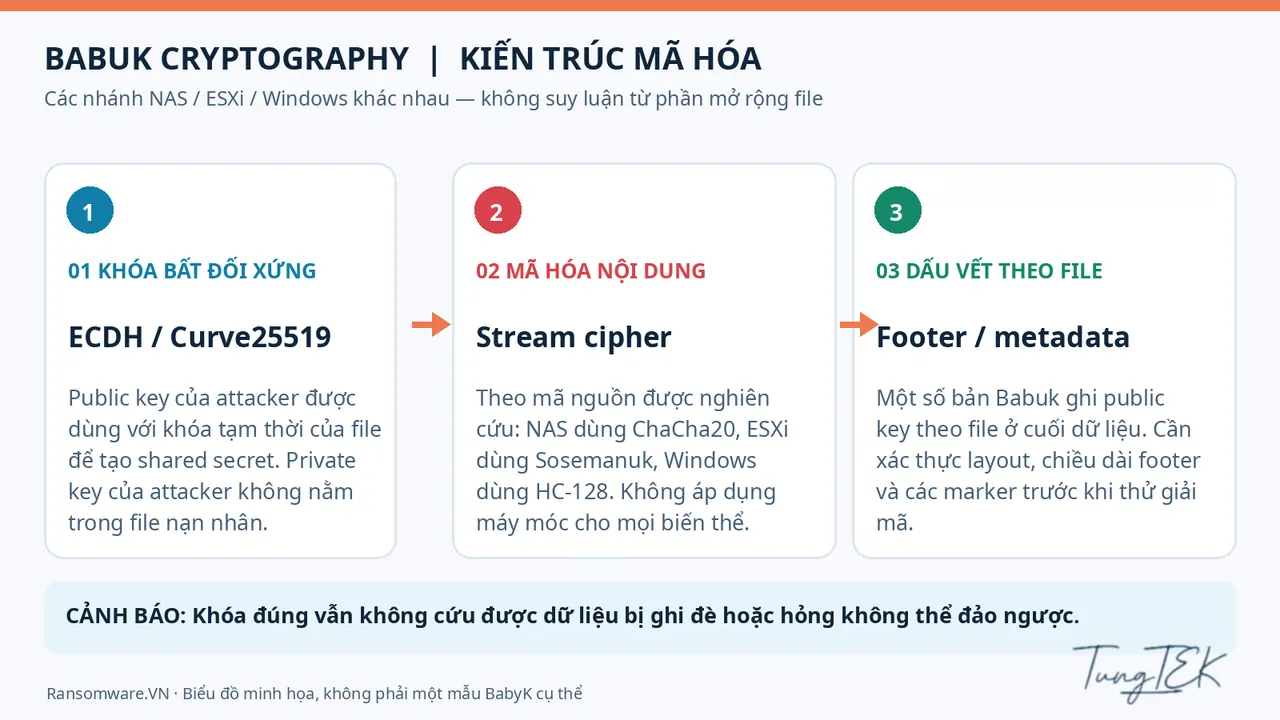
- SHA-256 of a file provides integrity evidence, not a decryption key.
- High entropy may also indicate compression or random data.
- Validate layout and footer length for the exact variant.
3. Emsisoft's verified ESXi decryptor failure
Emsisoft documented that an ESXi Babuk variant could repeatedly encrypt files or only rename files to .babyk without encryption. The attacker's decryptor could process unchanged files incorrectly and corrupt them. [S1]
This is documented for a studied ESXi sample; it does not prove an identical flaw for all BabyK NAS variants. Always test decryptors on verified copies and validate with the creating application. [S1]
- Never run decryptors on the sole original data copy.
- Start with representative copies and check application-level results.
- Pause bulk decryption if unexplained errors occur.
4. Encrypted, deleted and overwritten require separate recovery methods
Encrypted content may survive as ciphertext. Deleted file references may leave recoverable blocks. Overwritten data may no longer contain plaintext even if a correct private key becomes available.
These states can overlap: malware may write encrypted copies before deletion, snapshots may be lost, and unsafe recovery efforts can trigger new writes. Filesystems, snapshot behavior, RAID, TRIM and garbage collection affect outcomes.
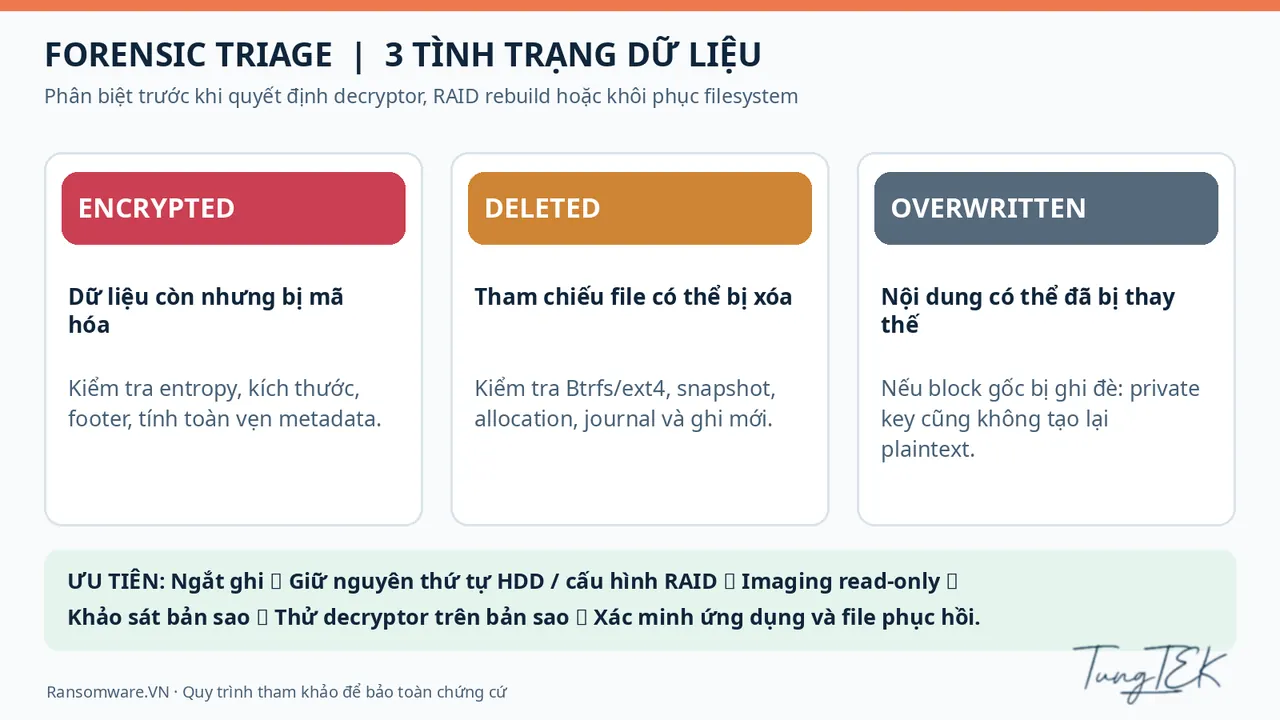
- Encrypted: assess headers, footers, transformed spans and known keys.
- Deleted: investigate metadata, snapshots, journals and allocation maps.
- Overwritten: identify damaged spans and partial salvage options.
- Corrupted: separate malware effects from RAID, filesystem and decryptor faults.
5. NAS forensics: preserve RAID and filesystem evidence first
For multi-disk NAS units, record drive identity and bay order, controller condition, RAID level, LVM, Btrfs/ext4 and snapshots before any recovery attempt. Wrong RAID reconstruction or unverified initialization can destroy remaining options.
Safe handling means reducing writes, obtaining read-only or forensic copies where appropriate, hashing copies and using a separate examination environment. Ransom notes and file extensions are starting indicators, not a substitute for storage evidence.
- Capture relevant logs, storage configuration and timelines.
- Label disk order prior to controlled handling.
- Avoid reset, format, initialize or rebuild on the only originals.
- Keep intrusion investigation distinct from file extraction.
6. Representative file analysis and application validation
Select samples across size and format classes: documents, images, archives, databases and virtual disks. Compare known-good exemplars where available, inspect magic bytes, per-region entropy, size deltas, pages and footer layout. Such observations help distinguish encryption from renaming or corruption.
Reading a recognizable header does not prove data restoration. Validate SQL databases for consistency and virtual machines for bootability and usable data. One file cannot represent the entire volume.
- Preserve encrypted originals for repeated analysis.
- Record file outcomes as valid, partial, unverified or damaged.
- Report only findings proven by the actual sample.
7. Free decryption: Tortilla is a scoped success story
On 9 January 2024, Cisco Talos described cooperation with Avast and Dutch Police to incorporate recovered Tortilla key material into the Babuk decryptor. It enables free recovery for supported samples and keys. [S3][S4]
That does not make every .babyk file decryptable: builders can use fresh key pairs and NAS/ESXi layouts differ. Attribute the variant, preserve the source and test only on copies. [S2][S4]
- Prefer Avast, Cisco Talos or No More Ransom guidance.
- Never experiment with untrusted tools on sole originals.
- Validate recovered applications, not just the completion message.
8. Ransom payments and a six-stage safe-response workflow
A payment cannot reverse overwriting or reconstruct irreversibly damaged filesystems. Emsisoft provides a concrete case in which an attacker-supplied ESXi decryptor could cause further damage; declaring every payment universally futile still goes beyond the evidence. [S1]
Suggested sequence: (1) isolate and halt writes; (2) document drive order, RAID and logs; (3) acquire verified copies; (4) identify file/metadata behavior and variant; (5) test recovery only on copies; (6) restore in a clean environment and validate access, application data and future backups.
- One successfully decrypted file is not a full recovery guarantee.
- Treat exfiltration risks separately from decryptability.
- Never publish a case-specific success probability without evidence.
9. Supported findings, remaining unknowns and next steps
Primary research supports distinct platform variants, broad reuse after source leaks, severe ESXi decryptor faults and recovered keys for some Tortilla variants. [S1][S2][S4][S5]
Without direct forensic evidence, one cannot conclude all files on a NAS were deleted, that original blocks were overwritten, that one key covers every file or that any particular recovery percentage applies. Artwork is editorial, not victim photography; AI assisted in preparing this article.
Research: https://Ransomware.VN. Specialist assessment and extraction of ransomware-encrypted data: https://CuuDuLieuMaHoa.com — TUNGTEK, +84 963 509 115. Preserve evidence and classify data state before attempting recovery.
Sources
Each source's scope and date are recorded separately when available. A citation does not independently verify every assessment.
Update history
· Published source-based analysis separating documented ESXi bugs from unproven NAS data-loss claims.
· Updated responsive artwork with the original transparent TUNGTEK PNG signature rendered white on a dark background, removing the white plaque; original article content, slug and publication date retained.
· Expanded bilingual analysis to 10 in-depth sections, added research sources and original-signature responsive artwork with links to two technical diagrams; kept original slug and publish date.
· Replaced two media URLs in article sections with Markdown image syntax to test inline rendering; original URL and publication timestamp unchanged.
Corrections policy