
VMware vCenter CVE-2026-123890: exploited zero-day and the risk to virtualization infrastructure
ARMORY CASTLE and BONESAW analysis, CVSS 9.8 patch guidance, IOCs, timeline, MITRE ATT&CK and a 24-hour runbook, separating observed exploitation from projected ransomware risk.
Updated: · Vietnam time (UTC+7)
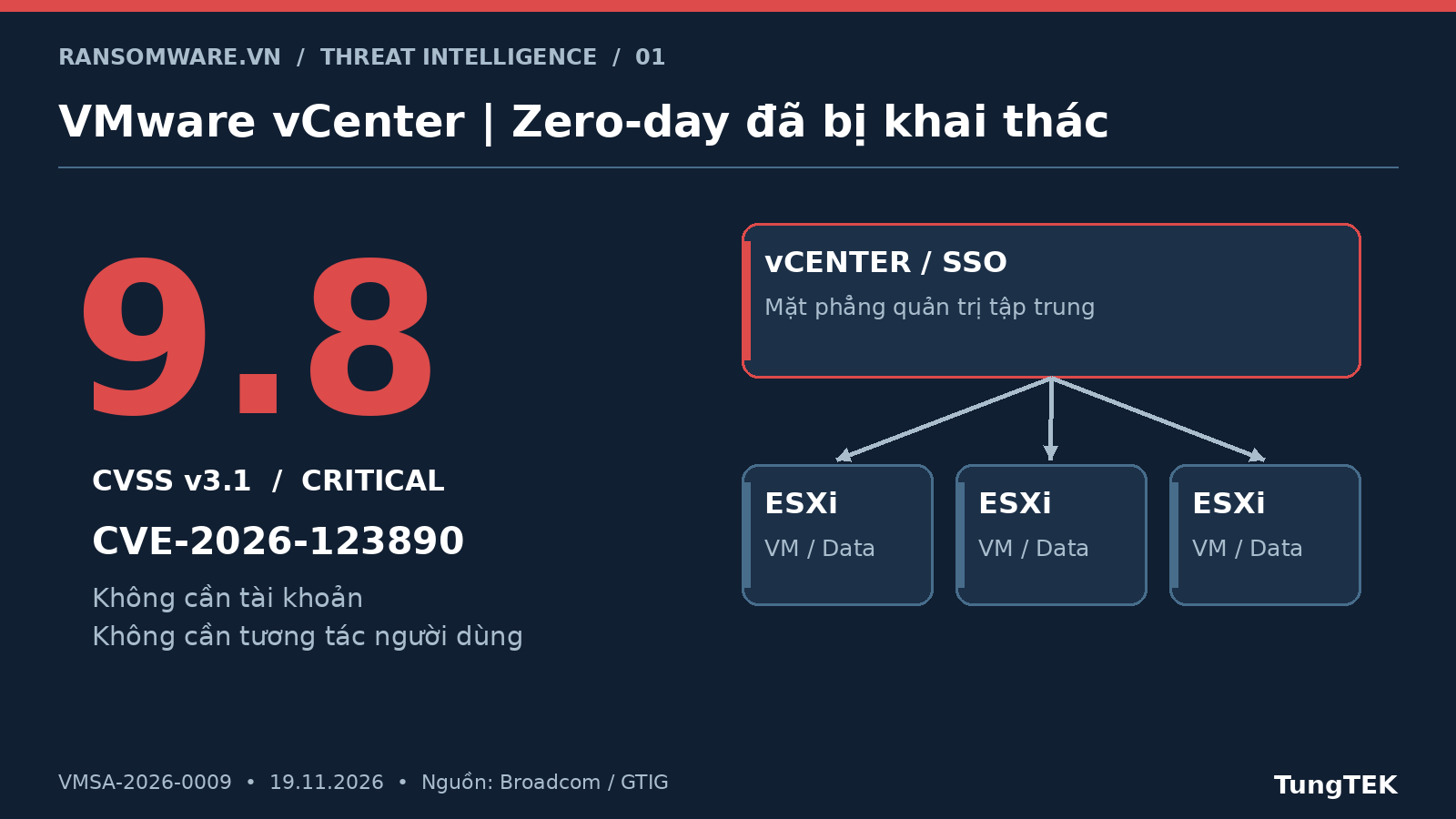
CVE, Critical CVSS 3.1 9.8 and patch matrix checked against Broadcom; exploitation reporting checked against GTIG/Mandiant and NHS on 20 November 2026. Verification covers the public sources, not an independent incident investigation or confirmation of ransomware use through this CVE.
Adapted from the complete TUNGTEK-supplied DOCX with AI-assisted editing. All five original illustrations retain their signature and composition. Exploitation, source-publication and article-publication dates are distinguished. Original image text remains Vietnamese; captions, ALT text and the complete analysis are in English.
CRITICAL · CVSS 3.1 9.8 · CVE-2026-123890
Exploitation reported by GTIG/Mandiant. Apply the vendor fix and investigate earlier exposure. Ransomware use through this CVE is not confirmed by the reviewed sources. [1] [2] [3]
Contents and navigation
An authentication vulnerability in VMware vCenter can open access to the virtualization management system without valid credentials. Broadcom released patches on 19 November 2026. The timing is particularly important: Google Threat Intelligence Group (GTIG) and Mandiant reported exploitation dating to early September, before a patch was available. [1] [2] [3]
Ransomware.VN assesses unpatched vCenter deployments as a P0 priority, especially when management interfaces are reachable from user networks, VPNs or remote-support appliances. Emergency patching and investigation for earlier compromise are separate tasks.
The essential distinction
Zero-day exploitation has been reported through real incident investigations. The sources reviewed do not establish that this CVE was directly used to deploy ransomware. This article treats that outcome as a risk scenario to prevent, rather than a confirmed event.
| Assessment | Source and limit |
|---|---|
| CVE and patches verified | Broadcom VMSA-2026-0009 and its official FAQ. [1] [2] |
| Exploitation reported in a real investigation | GTIG/Mandiant forensic findings; not independently reproduced by Ransomware.VN. [3] |
| Ransomware via this CVE | A conditional editorial risk scenario; no confirmed case established by the reviewed sources. |
| Local exposure or compromise | Requires asset, network and forensic validation in the organization’s own environment. |
Where the vulnerability sits
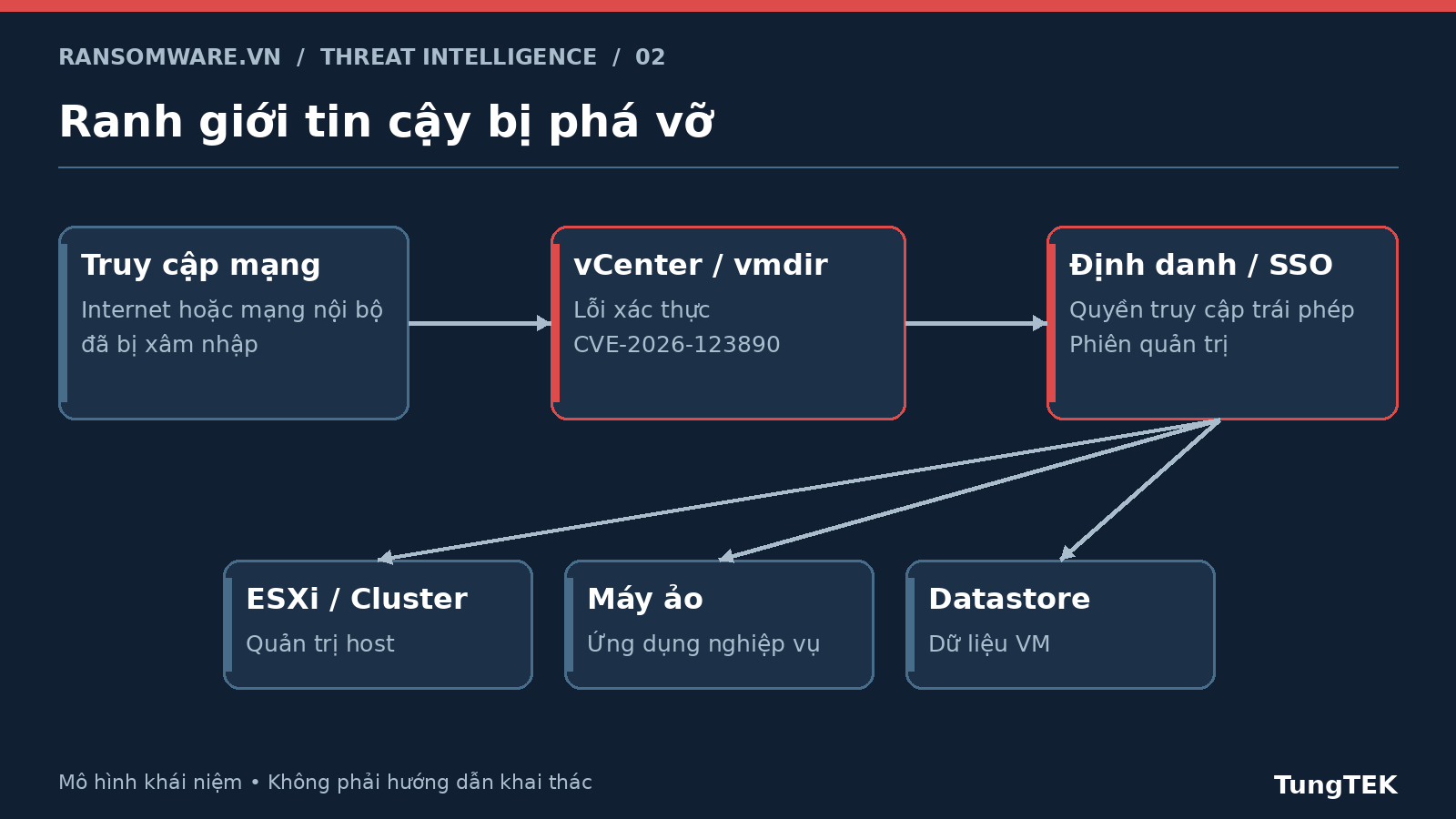
vCenter Server centrally manages ESXi hosts, clusters, virtual machines, permissions and lifecycle operations. VMware Directory Service (vmdir) is part of the identity system. A failure at that authentication boundary can turn a management service into a concentration of risk for many systems.
Technical identity
| Attribute | Value |
|---|---|
| CVE / CWE | CVE-2026-123890 / CWE-288 |
| CVSS 3.1 | 9.8 — Critical |
| Vector | AV:N/AC:L/PR:N/UI:N/S:U/C:H/I:H/A:H |
| Prerequisite | Network access to the affected service; no prior privileges or victim interaction required. |
| Impact | High confidentiality, integrity and availability impact under CVSS. |
Mandiant describes an SRP-6a session-key protection issue over DCE/RPC; the investigation recorded an unauthorized SSO administrator session. This is not a VM escape. CVSS measures technical severity, rather than the probability that any particular organization will be attacked. [2] [3] [4]
CWE-288 is retained from the source document and the GitHub Advisory Database classification, which is marked Unreviewed. Use the vendor advisory as the authority for remediation, rather than GitHub’s generic package fields. [4]
Campaign intelligence: ARMORY CASTLE
GTIG/Mandiant attribute the activity to ARMORY CASTLE (formerly UNC5221), a suspected China-linked actor. This is the investigating source’s attribution assessment, not an independent attribution by Ransomware.VN. [3]
| Date | Milestone | Evidence scope |
|---|---|---|
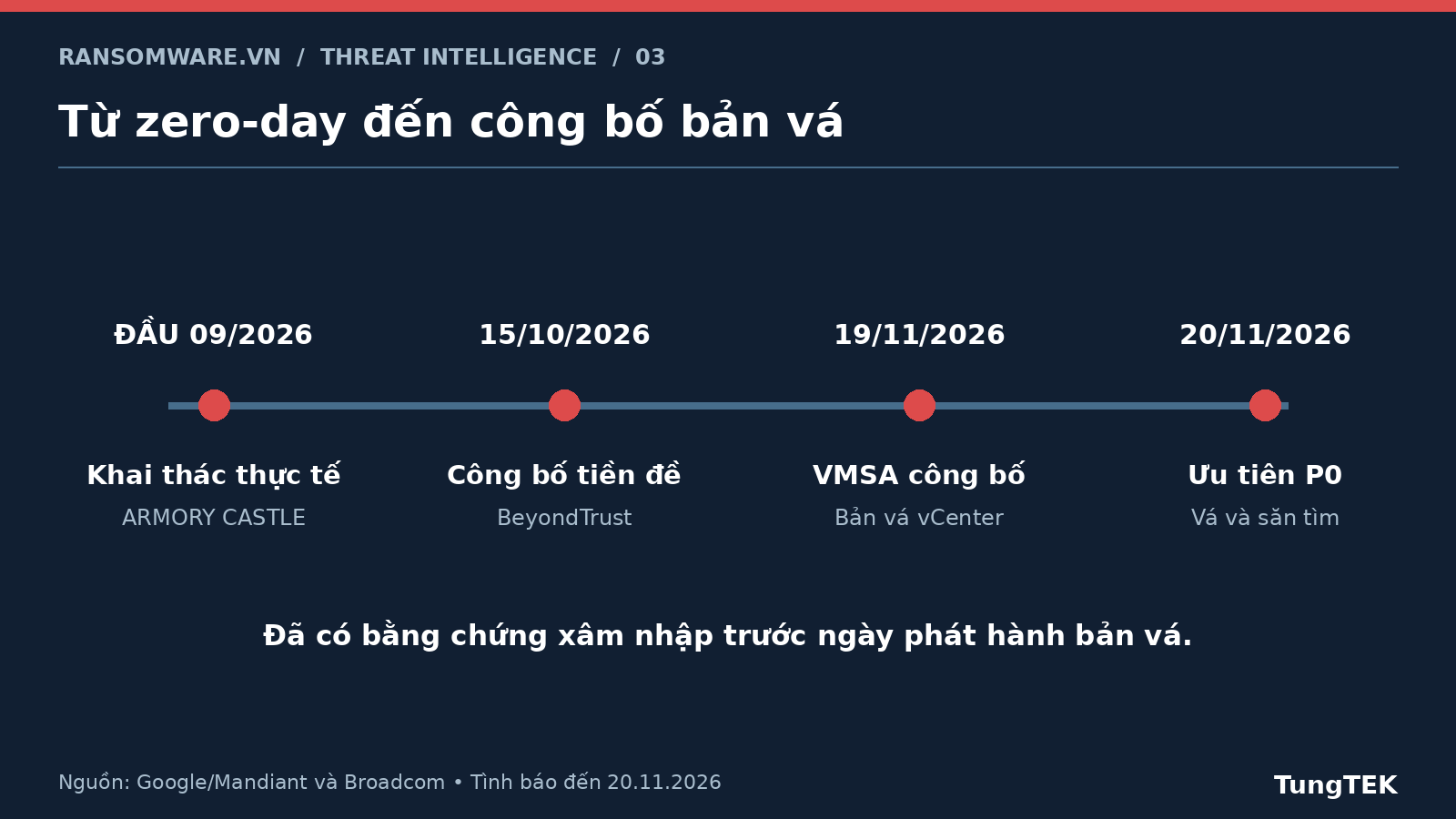
| Early September 2026 | BONESAW exploitation against vCenter | GTIG/Mandiant forensic evidence. [3] |
| 15 October 2026 | Earlier report on BeyondTrust activity | A prior campaign publication cited by GTIG; not the vCenter patch date. [3] |
| 19 November 2026 | Broadcom publishes VMSA; GTIG publishes vSphere research | Public disclosure and patch availability, distinct from the first observed exploitation. [1] [3] |
| 20 November 2026 (ICT) | Ransomware.VN source review and P0 recommendation | Editorial publication/response priority; not a newly observed attack. |
What the investigation observed
The intrusion began with exploitation of CVE-2026-102764 on a BeyondTrust Remote Support appliance. After moving into the internal network, the actor targeted vCenter with BONESAW; related utilities targeted identity data, SAML tokens and SSO accounts. ESXi artifacts also showed collection of virtual-machine data. [3]
| Tool / artifact | Role described by GTIG |
|---|---|
| BONESAW / SAWSNAKE | Utilities targeting vCenter / SAML identity. |
| SLIMSAVAGE / CAGEMATCH | Webshells supporting activity on Linux appliances. |
| BEARBONES / LAZYBONES | Backdoors supporting continued access to the compromised environment. |
Intelligence implications
Do not limit checks to Internet-facing systems. An internal vCenter can become a destination after a VPN, remote-support device or another appliance is compromised. A patch released yesterday does not mean the attacks began yesterday.
Affected versions and patches
Match the exact product branch and build. The following versions are the fixes listed in the VMSA, not a recommendation to downgrade a system already running a newer compatible, fixed release. [1] [2]
| Product / branch | Fixed release or required action |
|---|---|
| vCenter 8.0 | 8.0 U3m |
| VCF / VVF vCenter 9.0.x.x | 9.0.2.0200 |
| VCF / VVF vCenter 9.1.x.x | 9.1.1.0200 |
| VCF 5.x | 5.2.5; asynchronous patching procedure KB 88287 |
| vCenter 7.0 | Contact Broadcom under an extended support contract; no public fixed release is listed in the matrix. |
| vSphere 6.5 / 6.7 | Presume affected under the FAQ; these versions have not been fully evaluated. |
| Telco Cloud Platform / Infrastructure | Platform 3.0, 4.x, 5.0.x, 5.1.x, 5.2; Infrastructure 3.0. Consult KB 463116. |
For VCF 5.x, remediate the vCenter component with 8.0 U3m through the supported asynchronous process; 5.2.5 is the VCF/SDDC Manager release shown for that stack, not a vCenter 8.x build number. KB 463116 lists vCenter 8.0 U3m for the affected Telco Cloud branches. The table preserves the source document’s release labels; it does not invent numerical build IDs. [1] [2] [11]
Distinguish vCenter from the ESXi hypervisor
The FAQ confirms that the vulnerability does not depend on Enhanced Linked Mode. ESX/ESXi is outside the scope of VMSA-2026-0009. This CVE does not directly apply to a standalone hypervisor with no vCenter. Continue reviewing separate ESXi advisories. [2]
Deployment considerations
Broadcom lists no workaround. Network isolation is a compensating control and does not replace patching. This issue is distinct from CVE-2026-59309 in VMSA-2026-0006. Check the version/build under vSphere Client → Summary or VAMI; checking only the ESXi version is insufficient. [1] [2]
Four other CVEs disclosed in the same advisory
| CVE | Component / vulnerability | CVSS |
|---|---|---|
| 2026-123891 | SDDC Manager / SQL injection | 8.1 |
| 2026-123892 | SDDC Manager / command injection | 7.2 |
| 2026-123893 | SDDC Manager / local privilege escalation | 6.7 |
| 2026-123894 | VMware Tools for Windows / SAML signature bypass | 6.7 |
These issues have separate prerequisites. Do not assume that all are unauthenticated or have been exploited in the wild. Review the response matrix for each component in the advisory. [1] [9]
Why the ransomware risk matters
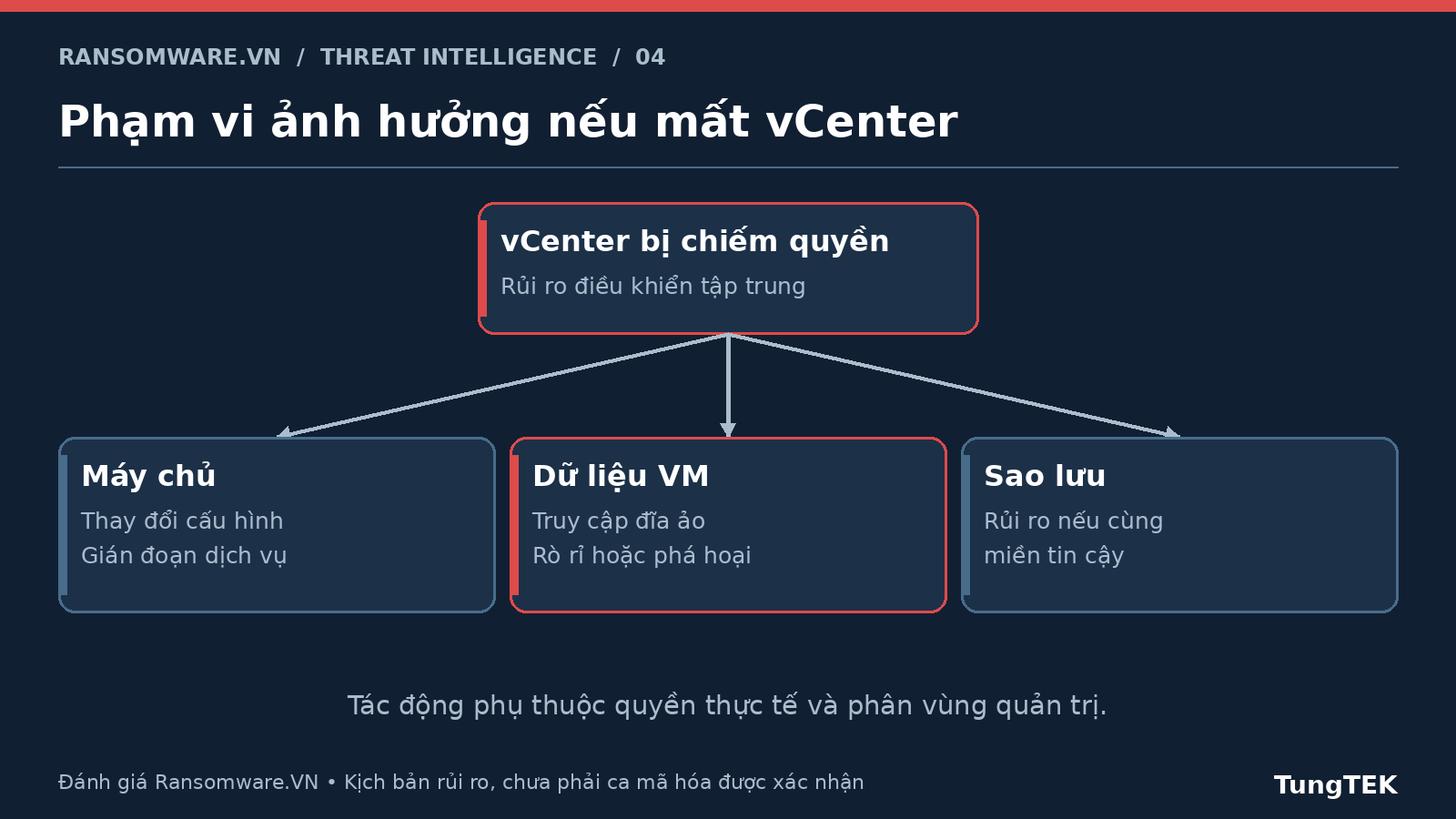
A vCenter manages many critical workloads. If administrative control is actually obtained and network access permits, an actor can expand impact beyond the original appliance. This is a conditional risk assessment, not a claim that a single exploit automatically encrypts every datastore.
Loss scenarios to prepare for
- Availability: unauthorized management operations can interrupt ERP, SQL, file servers and production applications.
- Confidentiality: access to VM data, copies or credentials.
- Integrity: changes to host, VM, permission or storage configuration.
- Recoverability: backups sharing the same administrative identity can be affected if the actor obtains the corresponding privileges.
A separate precedent: Microsoft reported ransomware actors exploiting ESXi through CVE-2024-37085 in 2024. This demonstrates the strategic value of virtualization to extortion actors, but does not establish any actor or exploit-code connection to CVE-2026-123890. [7]
Suggested priority
P0: an unpatched vCenter reachable from a less trusted zone, or a deployment showing signs of compromise. Unpatched but strongly isolated systems still require urgent remediation in the nearest safe change window.
The risk depends on three boundaries: whether a less trusted system can reach vCenter, which identities and management operations are exposed after compromise, and whether recovery copies have independent administrative control. Test each boundary separately. A VM snapshot on the same compromised management plane does not establish an independent recovery copy.
Threat hunting: IOCs and warning signals
The following are selected GTIG campaign artifacts, not a universal detection set for this CVE. Hunt only on systems you are authorized to administer. A match requires contextual validation. [3]
| File artifact | Classification |
|---|---|
| ActiveSer.jsp / u.jsp | Webshells on Linux appliances |
| /tmp/123 / /tmp/sss | BONESAW / SAWSNAKE |
| /tmp/dbr | BEARBONES |
| /usr/bin/vmtoolscs | LAZYBONES |
Selected network IOCs
103.147.251.5, 103.190.38.3, 118.174.128.34, 118.174.128.36, 118.174.128.38, 176.9.89.66, 185.71.15.109, 220.121.128.41, 222.108.77.44, 61.216.56.127, 81.45.89.43. These are suspected obfuscation-network addresses; do not treat an individual IP as independent proof of compromise. Consult the original IOCs/YARA in [3].
Log sources to collect
| Source | Suggested hunting signal |
|---|---|
| vmdir / SSO / STS | Anomalous sessions, new accounts, privilege-group changes and trust/certificate changes. |
| vpxd / vSphere Events | Host/VM operations outside the baseline, new permissions or unscheduled administrative actions. |
| VAMI / OS / SSH | Unplanned SSH enablement, unfamiliar SSH keys, new executables or interrupted logs. |
| Firewall / NetFlow / SIEM | Unexpected management-plane connections, especially TCP 2012, 443, 5480 and 22; egress outside the allowlist. |
| ESXi / backup / storage | Datastore operations, administrative sessions, retention changes, deleted copies or unusual jobs. |
Collect /var/log/vmware/ and centralized telemetry appropriate to the deployment. KB 312194 and KB 310254 describe log locations and SSO/authentication logs. [6] [10] Investigate back to early September 2026, or earlier where retained telemetry permits. Absence of an IOC does not establish absence of compromise.
Correlate a file/IP match with timestamps, source hosts, parent processes, account creation and management actions before escalation or blocking. Keep indicators as plain text and do not browse suspected infrastructure. If DEBUG logging is required, assess capacity and performance, preserve the original configuration and return to INFO after collection. [10]
MITRE ATT&CK: a defensive mapping
T1210 (Exploitation of Remote Services); T1136 (Create Account); T1021 (Remote Services); T1070 (Indicator Removal). This is an analyst-level defensive mapping, not an exhaustive official campaign TTP list.
| Technique | Defensive interpretation | What to correlate |
|---|---|---|
| T1210 — Exploitation of Remote Services | Lateral exploitation of an internal management service. | Source-to-vCenter traffic and the resulting SSO session. |
| T1136 — Create Account | Creation of an unauthorized SSO account. | Account creation, creator, group membership and role assignment. |
| T1021 — Remote Services | Remote access after credential/session compromise. | SSH/API sessions and the actions carried out under them. |
| T1070 — Indicator Removal | Selective removal or modification of traces. | Local artifacts against off-appliance logs; gaps alone are not proof. |
These four technique IDs were checked against MITRE. No ransomware-impact technique is presented as an observed part of this campaign. [12] [13] [14] [15]
A response runbook for the first 24 hours
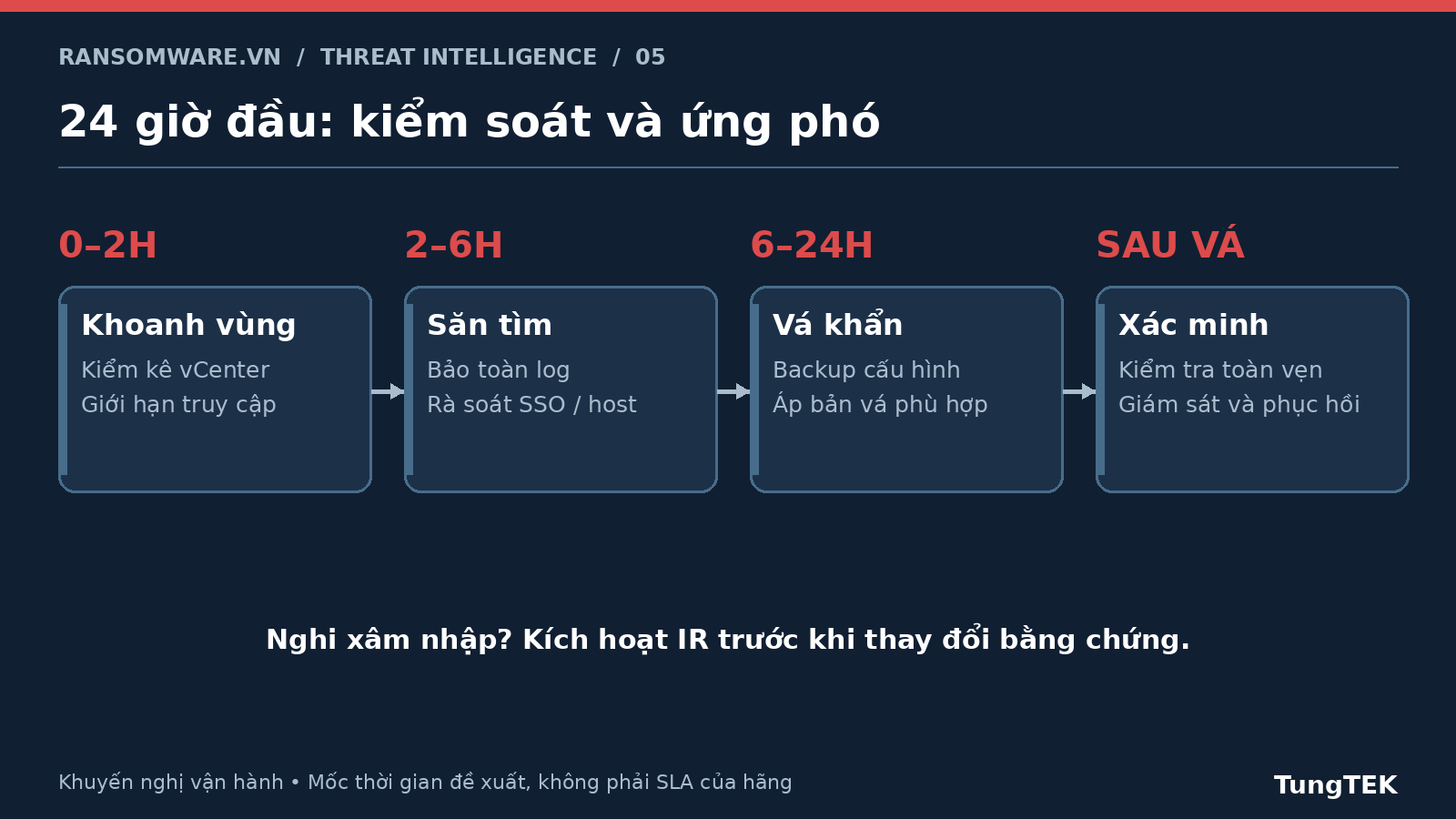
0–6 hours: inventory, containment and preservation
Identify vCenter instances, versions/builds, ELM/VCF topology, system owners and every access path. Remove direct Internet access. Apply management-network ACLs on infrastructure independent of vCenter, allowing only jump hosts and required operational flows. Disable unnecessary access after impact assessment; do not blindly block host-to-management traffic.
Export logs, support bundles and monitoring data to a trusted location, recording time, source and operator. If compromise is suspected, activate incident response, preserve evidence and establish scope before rebooting, rolling back or changing identities. Do not delay containment until the analysis is perfect.
6–24 hours: perform an emergency change
Check compatibility, free space, appliance health and a verified file-based configuration backup. Validate the upgrade path: the FAQ warns about Back-in-Time restrictions when upgrading to VCF 9.1.1 from certain newer builds. Coordinate with the vendor for integrated systems such as VxRail. [2]
The official FAQ specifies that vCenter 8.0 U3m and 9.0.2.0200 block an upgrade to VCF 9.1.1 under the Back-in-Time restriction. Validate the supported route with Broadcom before changing branches. These updates are not eligible for vCenter Quick Patch. [2]
Apply patches using a vendor-supported method, such as VAMI or the appropriate lifecycle/asynchronous process. Workloads generally continue running during a vCenter update, while management access is briefly interrupted. Check KMS, backup and dependent integrations. [2]
After patching
Verify the resulting build, SSO services, host connectivity, backups and alerts. Review pre-patch traces again. If compromise is confirmed, restore trust and credentials under the incident-response plan; a patch alone does not remove persistence.
Recovery, conclusions and references
Longer-term defense for Vietnamese organizations
Separate management and backup network zones. Use MFA-protected jump hosts, least privilege, separate administrative identities and remote syslog. Apply 3-2-1-1-0: three copies, two media types, one off-site copy, one offline/immutable copy and zero unresolved errors in recovery testing. Rehearse VM, SQL and file-server restores in a clean environment.
If VM data is encrypted or damaged, minimize writes to the affected datastore. Avoid running repair tools across VMDK/VMFS volumes or deleting snapshots/metadata before assessment. Prioritize preservation copies, restoration from known-clean backups, recovery against RTO/RPO and integrity validation before production use.
Related reading on Ransomware.VN
- VMware/ESXi: GERT investigation and administrative control
- ESXi CVE-2024-37085: a separate ransomware precedent
- Understanding ransomware
- Backup 3-2-1-1-0 and restore testing
- Recovery intelligence and data integrity
- A forensic timeline with traceable evidence
Conclusion
CVE-2026-123890 is a warning about protection of the virtualization management plane. Patching is mandatory, and an already compromised environment also requires investigation and re-establishment of trust. Protecting vCenter protects the organization’s ability to operate and recover.
Editorial note: the initial article [8] did not reflect GTIG’s exploitation report at review time. A public PoC, current CISA KEV status and a ransomware case using this CVE were not independently verified for this publication. This article contains no customer-system test results.
Sources
Each source's scope and date are recorded separately when available. A citation does not independently verify every assessment.
Update history
· Initial complete VI/EN analysis from the DOCX; checked Broadcom, GTIG/Mandiant, NHS and MITRE. Preserved all five original images, technical tables, IOCs, timeline and runbook; clarified VCF 5.x and unconfirmed ransomware use.
Corrections policy